
If AI can speak for you, your voice is now operational.
You don’t need a tone of voice. You need a voiceprint.

AI is making language cheap and average. “Friendly, clear, confident” is now corporate beige. If your brand can be swapped with a generic model output and nobody notices, you don’t have a voice. The job is recognition under compression.
Voice + sound as recognition system
Your business speaks through:
- product UI microcopy and error states
- support replies and escalation
- sales calls and demos
- bots and agent summaries
- onboarding flows
- audio: videos, podcasts, events, voice interfaces
- micro-sounds: notifications, confirmations, warnings
Question first if it “sounds like us?”, then shift to “Is this on-brand?” to finally identify…
Does this still sound like us when it’s compressed, repeated, and automated?
Voice and sound are often split
Most brand guidelines treat:
- voice = copywriting
- sound = marketing polish
People experience them as one: trust signature. If the copy is calm and accountable but the sound is hypey and urgent, it feels fake. If the sound is minimal and precise but the copy is verbose and performative, it feels incoherent.
I’ve seen this up close — Red Dot-winning sonic branding work at Scout24 with Rainer Hirt (audity GmbH). The brief wasn’t “make a catchy sound.” Sound only works when it’s aligned with how the business speaks and behaves. That’s what we did.
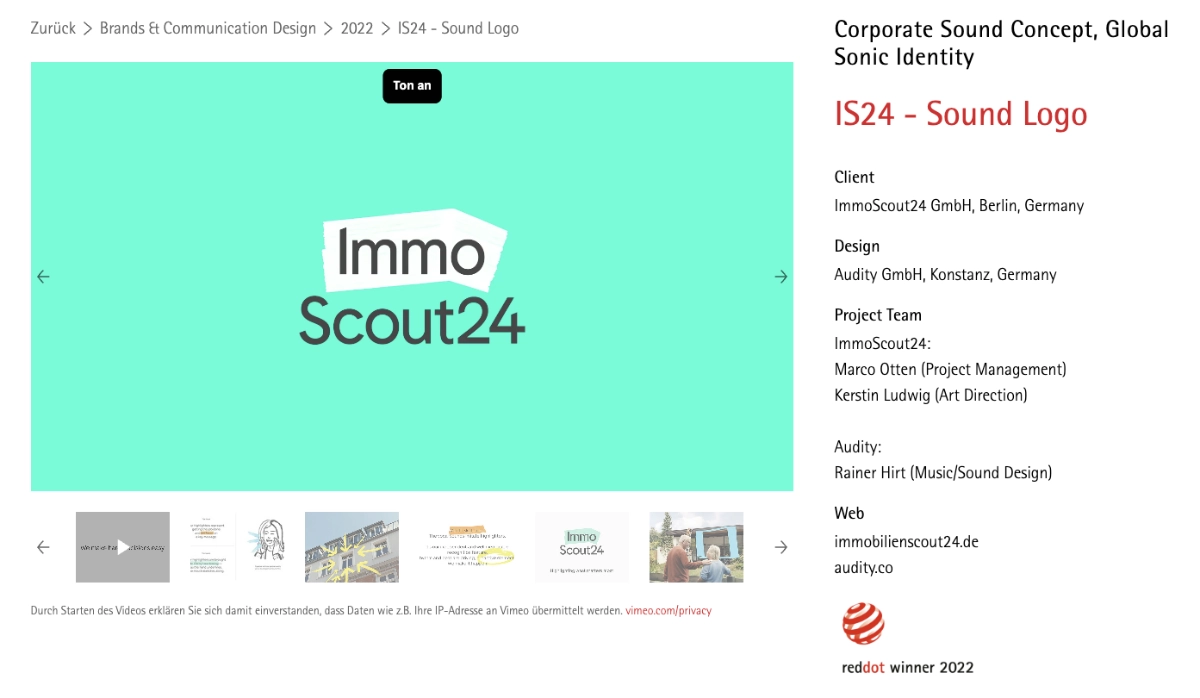
3-second recognizability
If someone hears a 3-second clip, reads a 2-line message, or gets a bot summary — would they recognize the brand without the logo?
If not: it’s just fluffy decoration depending on taste of stakeholders.
Do we really need this? What’s the ROI?
Tone isn’t a deck. It’s a margin lever. A voiceprint + sound library reduces variance across teams, UI, support, sales, and AI outputs. Variance creates a tax: lower conversion, more tickets, slower decisions, higher churn.
ROI looks like:
Clarity → fewer questions → fewer escalations → faster yes.
Bomo Piri (Studio Hamida, ex-Native Instruments) has a line I keep thinking about: the budget for a 30-second spot can fund a remix toolkit that lives forever in creator hands.
That’s the shift: media buy vs cultural infrastructure. A voiceprint + sound library is exactly that kind of infrastructure—built to travel, mutate, and still stay recognizable.
Tool: Voiceprint + Sound Library Card
Goal: recognizable under compression (humans + UI + bots + audio).
- Owner:
- Review gate:
- Update cadence:
Voiceprint (language)
- Stance under pressure:Pick 2: direct / calm / warm / clinical / playful / blunt
- Default posture:Explain / decide / invite / refuse
- Certainty rule:Non-negotiable, e.g. “No absolutes unless guaranteed.”
- Signature moves:Pick 3: Here’s what we know. / Here’s the constraint. / Here’s the next step.
- Taboo patterns:Ban list: seamless, effortless, world-class, always, just, simply, hype adjectives
- Proof style:How we earn trust: example / data / process / constraints
- Refusal line:How we say no
Human voiceprint (spoken)
This is how the brand sounds when a real person speaks for it.
- Vocal character:Calm / energetic | dry / warm | fast / steady / slow
- Casting rule:Real employees vs voice talent — when and why
- Incident mode:Slower + calmer + more accountable (never “excited”)
- Do / Don’t:
Sound library (music + cues)
- Base texture:Always on: minimal / warm / mechanical / organic / crisp / grainy
- Tempo bands:Slow (trust) / medium (flow) / fast (only when:)
- Timbre — avoid:
- Timbre — prefer:
- Recognition device:One motif (interval/rhythm), not a full song
Sonic moments
- Product:Confirm / warn / error / success / notification
- Support:Hold/queue / callback / apology moment
- Content:Intro/outro sting / transition
- Events:Walk-on / segment change / closing
Coherence rule
When it costs money / time / status, both language and sound move to: calmer, clearer, more accountable (never hype/urgency theatre).
Drift triggers
New bot / new market / new channel / incident / policy change / campaign spike
One example value: “We’re open.”
Voiceprint makes it real:
“We name why something is closed.”
Sound matches it:
Quiet, transparent, non-dramatic cues—no “ta-da” success sounds, no urgent pings for routine actions.
Closing thought
If a bot summarized you, support replied, and a founder spoke on a podcast — and those three didn’t sound like the same brand — that’s not a tone problem. That’s operational drift.
Next: Proof architecture — what agents trust.
Read
- McKinsey: Agentic commerce opportunity
- Bain: Zero-click search redefining marketing
- Search Engine Land: What is GEO?
- Mastercard: Agentic commerce standards
- Visa + Cloudflare: Trusted Agent Protocol
Agentic Brand Thinking
- 01Your brand is how your systems behave when no one is looking
- 02Your values are not random vibes. They’re your AI-ready operating logic
- 03 If AI can speak for you, your voice is now operational
- 04Proof is the new interface: What gets believed in AI-shaped journeys
- 05Policies are brand design
- 06If you don’t solve a real job, relevance is gone
- 07What to measure when touchpoints collapse into one answer
- 08Support is the new billboard
- 09Brand has a missing time horizon. This is how you fill it
- 10At AI scale, drift kills trust before you notice
- 11Brand Gov x AI: Who can change what, when
- 12Identity has to survive machine compression
- 13Brands don’t travel. People carry them.
- 14Agentic Brand: The system is the strategy