
Agentic Brand: The system is the strategy
What does a brand OS need for agents and humans to act without guessing?

I’ve been trying to solve this from both sides: compressing brand into something machines can read, and enabling agents to execute from identity. What you find in both directions is the same gap. Not a messaging problem. A specificity problem.
Erin Meyer (Author of The Culture Map) mapped how different cultures communicate: some direct, some indirect, but each with an underlying pattern a machine can learn. Most brands haven’t built that. Not because the culture isn’t there, but because it was never documented in a form anything can execute from. The values sound good. The tone guide exists. But the behavior under pressure (refusals, the costs, the character on bad days) almost none of it is written down.
That negative space is your lived culture.
It’s the part that actually carries identity.
And it’s almost always missing when a machine tries to represent you.
What exists instead is a cacophony of traces. Campaign copy. Policy language. Support scripts. A buzzword values page last updated three years ago. The machine reads all of it. None of it coheres. So it synthesizes a reasonable average; which is nobody’s brand.
That’s the problem this series was built to address. Thirteen modules aiming to preserve identity in agentic times.
What the series built
Each module addressed one surface where coherence holds or fractures — in the operational layer where decisions happen and trust forms before you’re in the room.
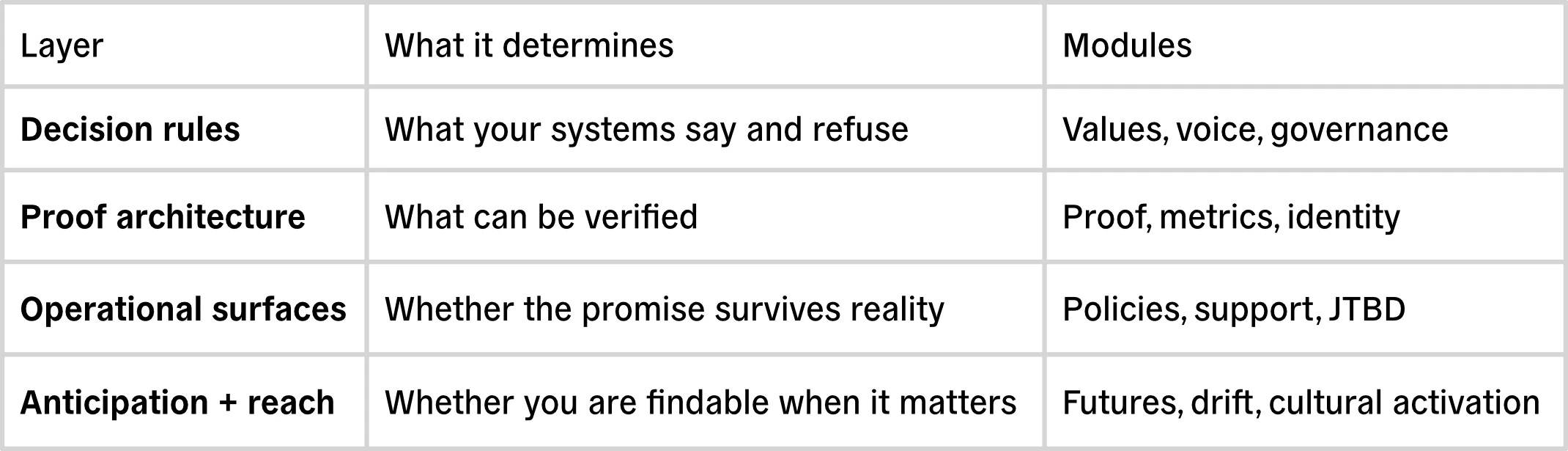
Four threads that make it a system
Thirteen modules address thirteen surfaces. Four threads connect them. Without these, the modules help individually but don’t compound.
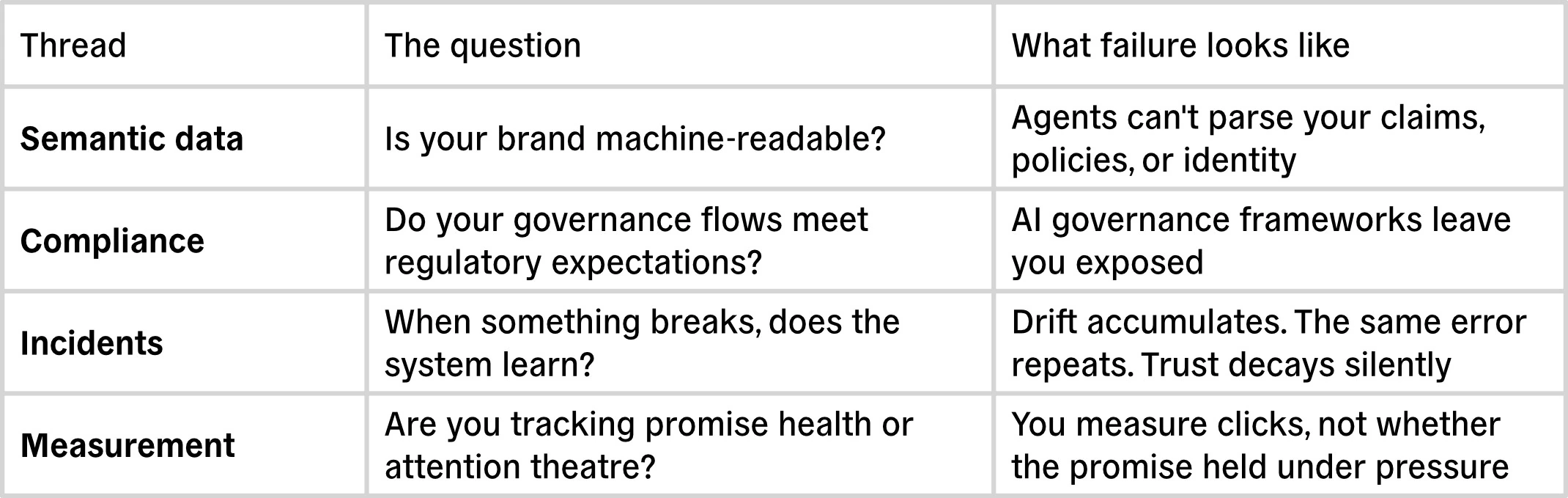
Verification and culture
12 reframed identity: it’s more culture than pixels. The verification stack — visual continuity, semantic data, provenance — carries the core. But the core is tangible commitments, not a design system. A logo refresh without structured data and provenance is decoration, not identity.
13 drew the line between coherence and affinity. Holding together under pressure is table stakes. Getting culturally carried — by creators, domain experts, communities — is a separate problem the OS must make possible. Coherence alone won’t create pull. The OS must make the brand worth carrying.
Verification is the floor.
Cultural activation is the ceiling.
You need both.
The remaining question
An Agentic Brand OS isn’t a product you install. It’s a coordination discipline you build, surface by surface, with named owners and honest scores.
The remaining question is who in your organization holds the mandate. Is it Brand? Marketing? Product? Legal? Data? Support? If it’s no one, then it’s everyone — which means it’s no one.
If no one owns brand coherence as a system,
everyone owns it as a problem.
Next
The next whitepaper in this series pulls all diagnostic tools together — where the OS leaks, and what to fix first.
Read
These books approach the same problem from different angles — communication patterns, culture as behavior, systems, strategy as refusal, operational language, and decision rights.
Communication pattern as executable system:
- Erin Meyer: The Culture Map
- Reed Hastings + Erin Meyer: No Rules Rules
Negative space / what you don’t do:
- Richard Rumelt: Good Strategy Bad Strategy
- A.G. Lafley + Roger Martin: Playing to Win
Systems behavior and drift:
- Donella Meadows: Thinking in Systems
Culture as behavior, not statement:
- Daniel Coyle: The Culture Code
Machine-readable language:
- Sarah Richards: Content Design
Decision rights / who holds the mandate:
- L. David Marquet: Turn the Ship Around
Agentic Brand Thinking
- 01Your brand is how your systems behave when no one is looking
- 02Your values are not random vibes. They’re your AI-ready operating logic
- 03If AI can speak for you, your voice is now operational
- 04Proof is the new interface: What gets believed in AI-shaped journeys
- 05Policies are brand design
- 06If you don’t solve a real job, relevance is gone
- 07What to measure when touchpoints collapse into one answer
- 08Support is the new billboard
- 09Brand has a missing time horizon. This is how you fill it
- 10At AI scale, drift kills trust before you notice
- 11Brand Gov x AI: Who can change what, when
- 12Identity has to survive machine compression
- 13Brands don’t travel. People carry them.
- 14 Agentic Brand: The system is the strategy